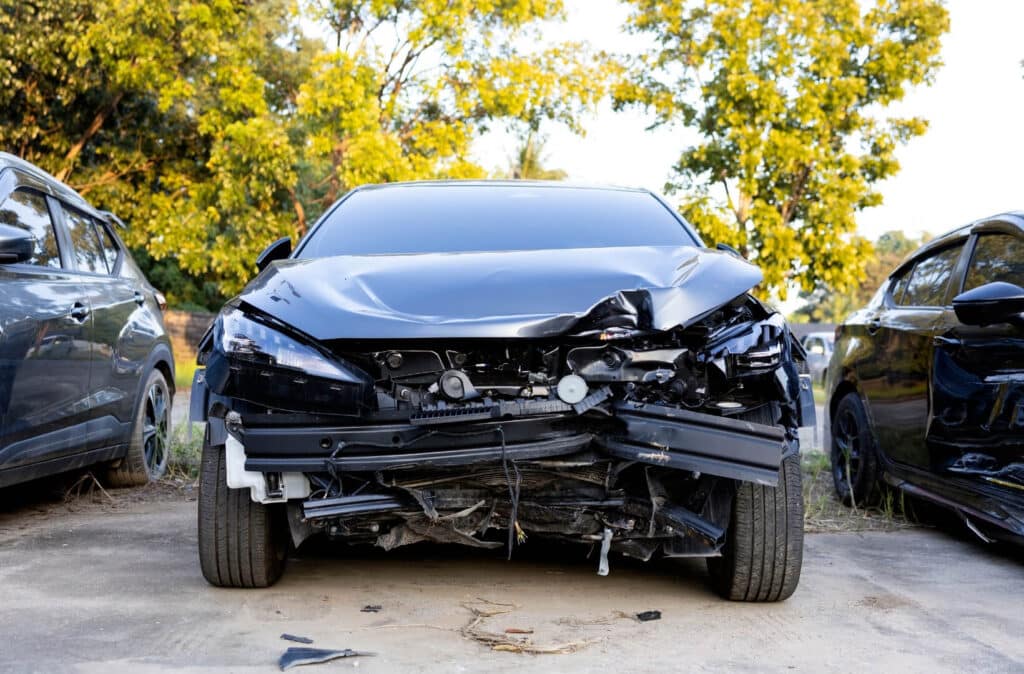
Your car is written off. Now you’re dealing with the insurer, the finance house, and a lot of questions you didn’t expect.
What actually happens next? And what are your options?
Here’s everything you need to know about write-offs in South Africa, from the insurer’s assessment to what you can do with what’s left.
Let’s begin.
What happens when your car is written off?
When your car is written off, your insurer decides that repairing it would cost more than the car is worth. They settle your claim by paying out the vehicle’s insured value (minus your excess) instead of covering the repair costs. The car is then deregistered on eNaTIS (the national traffic register), and you surrender the registration papers and number plates. If the vehicle was stolen or there’s any uncertainty about its history, a SAPS clearance may also be required before the process can be finalised.
To get the process started, you need to report the incident to your insurer as soon as possible and open a claim. They’ll send an assessor to inspect the damage, or what’s left of the vehicle.
Here’s a quick breakdown of what a write-off means:
- What happens when a car is written off: Your insurer pays out the car’s insured value instead of repairing it, and ownership of the wreck transfers to them.
- Write-off meaning: A vehicle is written off when the cost to repair it exceeds a set percentage of its value, or when it’s too badly damaged to repair safely.
- What happens when your car is written off in South Africa: The vehicle is deregistered on eNaTIS, number plates are surrendered, and a SAPS clearance certificate may be needed depending on the circumstances.
What is the retail value of my car, and how much will I get?
The retail value of your car is the price it would sell for at a reputable dealership on the open market. It’s the figure most insurers use to calculate your write-off payout. But it’s not the only valuation method out there, and the one in your policy determines how much you actually walk away with.
Here’s what you need to know:
- How retail value is defined: Retail value is the price a dealership would charge a buyer for the same vehicle in the same condition. It’s typically higher than trade-in or market value.
- How market value differs: Market value (sometimes called trade value) is what the car would fetch in a private sale. It’s usually lower than retail value.
- Which value your policy likely uses: Policies vary by insurer. Some use retail value, others use market value, and some let you choose. Retail value gives you the better payout. Check your policy schedule and look for “sum insured basis.”
- How depreciation affects your payout: Cars lose value the moment they leave the showroom. The older your car, the lower the retail value, and the lower your payout. If your cover hasn’t kept pace with the car’s actual age and condition, you may get less than you expect.
- How to dispute a low settlement offer: If the insurer’s offer seems low, you can challenge it. Get an independent valuation from a registered dealer or valuation service and submit it to your insurer. If you’re still unhappy, you can escalate to the National Financial Ombud (NFO), which handles short-term insurance disputes.
Retail vs market value
The valuation method in your policy isn’t just a technicality. It determines how much money lands in your account.
Check out this table.
Difference between retail value vs market value
| Retail value | Market value | |
| What it is | The price a dealership would sell your car for | The price your car would fetch in a private sale |
| Which is higher | Retail value, usually by a meaningful margin | Lower, especially on older vehicles |
| Who uses it | Offered by most SA insurers; often a policy-level choice | Also widely offered; some insurers use this as their standard |
| Payout outcome | Better settlement for you | Lower settlement for you |
| What to check | Your policy schedule, look for “sum insured basis” | Same, it’ll specify retail or market value |
If your policy uses market value, you could receive significantly less than you’d get at a dealership. It’s worth knowing before you need to claim.
What does “uneconomical to repair” mean?
“Uneconomical to repair” doesn’t mean your car is crushed beyond recognition. It means the cost to fix it exceeds a threshold set by your insurer. That threshold is lower than most people expect.
In South Africa, the typical range is 60-75% of the vehicle’s retail value. So if your car is worth R200 000 and repairs come to R130 000, your insurer may write it off, even if it looks fixable to you.
Some insurers don’t use a fixed percentage at all. They factor in historical salvage data: what a vehicle like yours, in that condition, would sell for at auction. If the salvage value plus the repair cost exceeds the retail value, it’s a write-off.
Even seemingly minor damage can trigger a write-off. A compromised crumple zone, a deployed airbag, a bent chassis: the parts and labour costs add up fast.
Write-off codes in South Africa: Code 2, Code 3, Code 3A, and Code 4
Once your car is assessed and written off, it’s assigned a write-off code. That code determines what can be done with the vehicle.
Check out this table.
Write-off codes explained
| Code | What it means | Can it be repaired? | Can it be re-registered? |
| Code 2 | Standard used vehicle status. A car written off as “uneconomical to repair” can retain this code, meaning no write-off flag appears on eNaTIS. | Yes, if damage is non-structural | Not applicable. The car retains its Code 2 status |
| Code 3 | Declared permanently unfit for use due to structural damage requiring substantial rebuilding. Officially designated “built-up” on eNaTIS. | Yes, after SAPS clearance and a full roadworthy inspection | Yes, but permanently carries “built-up” Code 3 status. It cannot revert to Code 2 |
| Code 3A | Designated for spare parts only. Cannot be rebuilt or returned to the road. | No | No |
| Code 4 | Permanently demolished. The chassis has been destroyed to the point that neither the vehicle nor its parts can be used. | No | No |
The code is assigned by the insurer and recorded on eNaTIS. It follows the vehicle permanently. A Code 3 “built-up” vehicle is the only write-off category that can legally return to the road, and only after a roadworthy inspection and SAPS clearance.
One important caveat: vehicles written off as “uneconomical to repair” under Code 2 retain their standard used vehicle status on eNaTIS, with no formal write-off flag. This is why running a history check through a service like FirstCheck matters even when buying what appears to be a clean Code 2 car.
By now, it should be clear that the write-off code isn’t just paperwork. It determines every option available to you.

Do you pay excess if your car is written off, and do you still pay insurance?
Yes, excess is payable on a write-off claim, just as it would be on a repair claim. The insurer deducts it from your settlement payout.
Here’s what you need to know about excess and insurance after a write-off:
- Yes, excess is payable: Your policy excess applies to every write-off claim, regardless of fault. Even if the other driver caused the accident, the excess is still deducted from your payout before you receive it.
- When premium payments stop: Your cover and your premium obligation end when your claim is settled, and the vehicle is deregistered. Until that point, you’re still covered and still liable for premiums.
- Why cancelling cover too early is a risk: If you cancel your policy before the claim is finalised, you could find yourself uninsured during the gap. That’s a problem if anything else happens to the vehicle in the meantime.
- What to do in the gap between settlement and replacement: If you’re buying a replacement vehicle, arrange car insurance before you drive it off the lot. Don’t assume your old policy carries over. It won’t.
What happens if my car is written off and it’s on finance?
If your car is financed, the insurer doesn’t pay you directly. They pay the finance house first.
That’s because the bank, not you, technically owns the vehicle until the loan is paid off. The car is their security. So when a write-off claim is settled, the payout goes to settle the outstanding finance balance first.
Here’s what that means in practice:
- Insurer pays the finance house first: The settlement amount is paid directly to your bank or vehicle finance provider to clear the outstanding loan.
- You receive any remaining balance: If the payout exceeds what you still owe, the difference comes to you. If your car was worth R180 000 and you owed R120 000, you’d receive R60 000.
- What happens when the payout doesn’t cover the outstanding amount: This is where things get difficult. If you owe R180 000 and the car is only worth R140 000, you’re still responsible for the R40 000 shortfall, even though the car is gone.
- Balloon payments as a specific shortfall risk: Balloon payment structures are common in South African vehicle finance. If a large final payment is due at the end of the term, your outstanding balance can be significantly higher than the car’s current value, especially after depreciation. A write-off in this scenario can leave a painful gap.
- What credit shortfall cover is: Also called “top-up cover” or “gap cover,” credit shortfall insurance covers the difference between your insurer’s payout and your outstanding finance balance. Not all policies include it. Check yours.
- Your obligations to the finance provider: Even after a write-off, you remain contractually obligated to settle any shortfall with the finance house. That debt doesn’t disappear with the car.
⚠️ If you’re not sure whether your policy includes credit shortfall cover, call your insurer before you need to claim. Adding it is far cheaper than carrying the shortfall yourself.
If the shortfall goes unpaid and you’re struggling to keep up, it helps to understand how the car repossession process works in South Africa, and what you can do to protect yourself.
What are your options after a write-off?
Once your insurer settles the claim, you have four broad paths: accept the payout and move on, keep the wreck, buy it back at salvage auction, or rebuild and re-register it.
Which options are available to you depends on the write-off code assigned to your vehicle and whether it’s on finance. Both were covered in the sections above.
Here’s a quick summary of what readers commonly ask:
- Should I accept the payout and move on? This is the most common outcome. If it makes sense, take the settlement, clear any finance, and use what’s left toward a replacement.
- If my car is written off, can I keep it? Sometimes, but only if the car isn’t financed and your insurer agrees, and only with a reduced payout.
- Can I buy back a written-off car? It is possible, but the salvage value is deducted from your settlement, and you may need to bid at auction if you don’t act quickly.
- Can a written-off car be re-registered in South Africa? Only if it’s a Code 3 vehicle that has been rebuilt to roadworthy standard and passed the required inspections.
Accepting the payout and moving on
For most people, this is the path: take the settlement, clear any finance, and use what’s left toward a replacement.
Your payout is based on your vehicle’s insured value (retail or market, depending on your policy) minus your excess. If the car was financed, the bank gets paid first. Whatever remains comes to you.
One thing to plan for: depreciation means the payout often doesn’t stretch to a like-for-like replacement. A car that cost R250 000 three years ago may only pay out at its current retail value, which could be significantly lower. Budget accordingly before committing to a replacement.
If you need to finance a new car, here’s what you need to qualify for car finance in South Africa.
If my car is written off, can I keep it?
The car must not be financed, and your insurer must agree. If they do, they’ll deduct the salvage value from your settlement, what the wreck would have fetched at auction.
So you get less cash, but you keep the car.
What if my car is on finance: can I still keep it?
Generally, no.
The bank owns the vehicle until the loan is paid off. If the car is written off while you still have an outstanding balance, the payout goes to the bank first. If your finance agreement includes any options for retaining the vehicle, your finance provider will tell you, but most don’t.
Buying back a written-off car
If you want the vehicle back, the formal route is a buyback. The insurer takes ownership of the wreck, assigns it a salvage value, and deducts that amount from your settlement. In exchange, you get the wreck back.
The right-of-first-refusal issue
Here’s something most people don’t know until it’s too late.
Once your claim is settled, the insurer owns the vehicle. If you didn’t arrange the buyback before settlement, you may lose the right to purchase it directly. The wreck gets sent to a salvage auction. If you want it, you’ll need to bid for it like anyone else.
So if keeping the car is your intention, tell your insurer before the claim is finalised. Ask about the buyback option and the salvage value upfront. Don’t wait.
Can a written-off car be re-registered in South Africa?
It depends entirely on the write-off code.
Code 3 vehicles can be rebuilt and re-registered, but only after passing a roadworthy inspection and obtaining a SAPS clearance certificate. Once those are in hand, the vehicle is re-registered on eNaTIS with a permanent “built-up” (Code 3) status. That status is permanent and visible to any future buyer.
Code 3A and Code 4 vehicles cannot be re-registered. A Code 3A vehicle is designated for spare parts only. A Code 4 has been permanently demolished. Neither can legally return to the road.
So if you’re buying a written-off vehicle to rebuild, make sure it’s a Code 3. Verify that on eNaTIS before you hand over any money.
If you’re considering buying a previously written-off vehicle, always run a history check first. FirstCheck or a similar service will show you the write-off code and any finance interests still registered against it. Code 2 write-offs won’t appear on these checks; a clean result doesn’t guarantee the vehicle has never been written off.
⭐ Related content:
Final thoughts
A write-off is stressful enough without discovering mid-claim that your payout doesn’t cover your finance balance, or that you’ve lost the right to keep the car.
Knowing how the process works puts you in a better position to ask the right questions and push back when you need to.
Consider all of your options before you accept a settlement offer.
If a write-off has put you under financial pressure cause the shortfall has left you struggling, talk to our team.
We can help balance your income and expenses by reducing how much you have to pay toward debt each month. Visit My Debt Hero to see if you qualify and get started.